What Do You Feed Your Baby Until Your Milk Comes in
If you discover yourself fretting over your newborn feeding schedule, you're not lone. Questions like "how much should a newborn eat?" and "how frequently should I feed baby?" are some of the well-nigh common concerns among new parents. After all, infant is growing by leaps and bounds. They'll abound more in the offset year than at whatsoever other indicate in their life, doubling in size by the time they're 5 months former and tripling by the cease of the first year—and then information technology'due south important to feed infant the fuel they need to ability through each stage of development. Whether you lot opt for chest milk or formula, here's what you lot need to know to make sure babe is eating enough.
In this commodity:
How much breast milk should a newborn eat?
How much formula should a newborn consume?
What if you're breastfeeding and formula-feeding?
Signs baby is getting enough milk
Newborn feeding FAQs
How Much Breast Milk Should A Newborn Eat?
Wondering how much a newborn should swallow? "As pediatricians, nosotros say to feed on demand," says Jennifer Trachtenberg, MD, a pediatrician in New York City and an assistant clinical professor of pediatrics at The Mount Sinai School of Medicine. And luckily, when all goes right, breastfeeding is an ingenious, cocky-sufficient system. When baby suckles, it stimulates your breasts to produce just the right amount of milk to encounter your child's nutritional needs. When infant needs more than (because of a growth spurt, for example) they suckle more, causing your body to crank up product. Genius. Of grade, that's presuming that baby—and your breasts—cooperate.
It'due south hard to clock how much a newborn eats when y'all're breastfeeding. Use these guidelines to make sure baby is eating enough.
How many ounces should a newborn eat at a fourth dimension? From the time your milk comes in a few days after birth, baby will likely take in 2 to 3 ounces at each feeding, working their way up to 4 ounces by the finish of the kickoff calendar month. To gauge roughly how much milk baby needs, try this quick, easy adding: Multiply infant's weight by 2 and a one-half. For example, an eight-pound baby should be eating about 20 ounces a twenty-four hour period.
In terms of how often you should feed baby, you tin can look a newborn to breastfeed every bit much every bit every two to three hours (or more!), or 8 to 12 times a day. While baby (and mom) are still figuring out how to breastfeed, information technology can take 20 to 45 minutes per feeding, or more than. Just all that suckling helps to found your milk supply, so information technology's time well spent. Equally baby'due south stomach gets bigger and can hold more milk at a fourth dimension, they'll be able to go longer between feedings—well-nigh 3 to four hours. They'll also become more efficient, usually taking in ninety percent of the milk they demand inside the first ten minutes of nursing.
How Much Formula Should A Newborn Swallow?
I advantage to formula-feeding is parents tin can mensurate every ounce of milk baby guzzles down. But information technology can pose its ain challenges too: While babies are blissfully complimentary from concepts like the clean plate (or empty bottle) order, parents aren't. Here'south a breakdown of how much formula a newborn should consume.
Ounce for ounce, formula has the same average calories as breast milk, so the total corporeality that breastfed and formula-fed babies will need to eat in a twenty-four hours is basically the aforementioned: about two and a half times baby's weight in pounds. The newborn feeding schedule for formula, however, might be a piddling different. Since babies tend to assimilate formula more than slowly, they'll get longer betwixt feedings. Baby will likely become hungry every three to four hours, eating well-nigh 2 ounces per feeding equally a newborn and progressing to 4 ounces past the finish of the first month. Expect to add together about an ounce per month until babe is eating 6 to eight ounces of formula at a time, which usually happens when infant is 6 months of historic period. In full general, 32 ounces of formula a solar day is the most infant will ever need. (When they're hungry for more than that, it may hateful they're gear up to start eating solids, which typically happens around the vi-month marker.)
What If You're Breastfeeding And Formula-Feeding?
For moms who exercise a blend of breast milk and formula, there are no set up rules for how often and how much a newborn should swallow of each. Yous'll desire to aim for at least six to eight feedings per day of one type of milk or the other (fewer as baby gets older)—just since breast milk and formula are nutritionally equivalent, it'due south merely a matter of finding the mix that works best for you lot and baby. Yet, the American Academy of Pediatrics recommends sectional breastfeeding for the first 6 months if possible. Even if y'all plan to eventually supplement with formula, breastfeeding during that critical catamenia can help meliorate establish your breast milk supply for the months ahead.
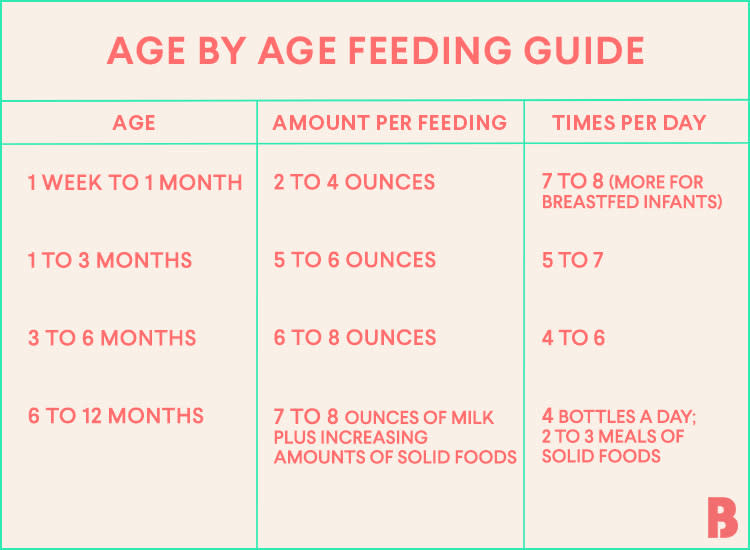
Age-By-Age Feeding Guide
Still wondering how much a newborn should eat, and how oftentimes? The following feeding nautical chart, based on data from the Children'south Hospital of The King'south Daughters, breaks downwards feeding amounts and frequency by age, so you lot don't have to constantly worry if y'all take a hungry baby on your hands. When babe is around six months one-time, you lot can showtime introducing solid foods into baby's diet (which is a whole new exciting adventure).

Signs Babe Is Eating Enough
When it comes to newborns, how often you should feed baby depends on how much milk your newborn wants. Keep an center out for signs y'all have a hungry baby—similar if they wake up and start rooting, or suckling or moving their mouth—preferably earlier they start fussing or crying. Pay attention to infant'due south cues even while you feed. You'll know they're even so hungry if they're actively suckling and audibly swallowing. When baby stops suckling, relaxes their easily and has that sleepy, relaxed "milk-drunk" await, yous'll know they've eaten plenty.
Checking infant's diaper tin can also give you a clue as to whether baby is eating enough: A moisture diaper every 3 to four hours is a good sign. Stools tin can be more than variable: Some babies poop every time they swallow, others merely once a day.
Only at the end of the day, "how baby is acting and growing are the about important [signs]," Trachtenberg says. By measuring baby's weight gain, your pediatrician will be able to tell if your child is thriving. Babies commonly gain about half an ounce to two ounces per twenty-four hours for the first three months, says Meryl Newman-Cedar, Physician, a New York Metropolis-based pediatrician and clinical instructor of pediatrics at Weill-Cornell Medical Center. But keep in mind that the big picture is more of import than any unmarried weigh-in. "In full general, you want to see baby'southward peak and weight basically follow their own growth bend," she says.
Newborn Feeding FAQs
Should I wake baby for feedings?
"I tell parents not to wake a sleeping babe," Trachtenberg says—at least once baby has gained back their nascency weight and is standing to feed every three to four hours during the daytime. (It's normal for newborns to lose weight in the first few days of life and then gain information technology back.)
Should I wake baby if they doze off during a feeding?
Some doctors say yep. "When that happens, baby eats so slowly that one feeding runs into the next feeding time—and parents find themselves with little time for annihilation else," Newman-Cedar says. Try slightly undressing baby, tickling their feet or patting their bottom to get back on job.
Is baby eating as well much?
While babe is naturally enlightened of when they're hungry and when they've had their make full, it's possible for well-meaning adults to coax infant into overeating, especially from a bottle. To avoid overfeeding, scout for signs babe is full, such equally turning their head, pushing the canteen away or fussing. And don't be likewise focused on making sure infant finishes every last drib. Trachtenberg suggests putting no more than a one-half-ounce more than yous await baby to eat at each feeding in a bottle. If baby drains that too, y'all'll know information technology'due south time to add a little bit more. But go slowly: Try pausing halfway through the bottle, sitting baby up and burping them—and so encounter if they actually want more than.
Should I worry that baby is losing weight?
Don't stress: It's totally normal for newborns to really lose weight in the outset few days of life—up to 7 to 10 percent is considered adequate. Beyond that, your doc may advise you to supplement with formula to ward off dehydration and low blood saccharide.
If baby isn't getting enough calories, yous'll start to meet a lag in growth, Newman-Cedar says. It starts with a decrease in baby'south weight, then length and lastly head circumference, since the body prioritizes the encephalon when nutrients are scarce. Simply when it comes to infant's growth, bigger isn't necessarily better. It's all about the growth curve. "If you have parents who are thin and the kid is in the 10th percentile, that's probably normal for that child," Newman-Cedar says.
Call your pediatrician if baby has a fever; is lethargic, refusing to eat or vomiting a lot in between feedings; isn't urinating at least every four to six hours; or if baby'southward urine is very concentrated (dark xanthous).
Expert bios:
Jennifer Trachtenberg, MD, is a pediatrician with Carnegie Hill Pediatrics in New York City, where she has been practicing for over 20 years, as well as an assistant clinical professor of pediatrics at The Mountain Sinai Schoolhouse of Medicine. She earned her medical caste in 1993 at The Mountain Sinai School of Medicine and is the author of 2 parenting books, The Smart Parent's Guide to Getting Your Kids Through Check Ups, Illness and Accidents, and Expert Kids, Bad Habits: The Real Age Guide to Raising Healthy Children.
Meryl Newman-Cedar, Doctor, is a New York Urban center-based pediatrician at Upper East Side Pediatrics, an attending pediatrician at NYPH-Cornell and a clinical instructor of pediatrics at Weill-Cornell Medical Middle. She attended medical school at the SUNY-Downstate Medical Center and has been in individual practice since 1986.
Updated January 2020
Please note: The Crash-land and the materials and information information technology contains are not intended to, and do not establish, medical or other health communication or diagnosis and should not be used equally such. You should always consult with a qualified physician or wellness professional virtually your specific circumstances.
Plus, more from The Bump:
gearyyourstrather.blogspot.com
Source: https://www.thebump.com/a/how-much-should-a-newborn-eat
0 Response to "What Do You Feed Your Baby Until Your Milk Comes in"
Post a Comment