Night of the living ants
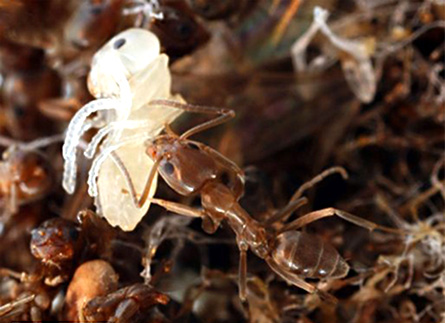 |
| Ant nests get great mortician capacity. Workers notice the dead and drag them outside to a pile of debris and corpses, often inside an hour after death. Here a worker carries a childlike ant in the immature stage to the refuse pile. |
| Photo courtsey of the National Academy of Sciences and PNAS |
When an ant dies, other ants move the dead worm out of the nuzzle. Sometimes, the pulseless ant gets moved away very soon — within an hr of dying. This behavior is unputdownable to scientists, World Health Organization admiration how ants know for sure — then before long — that another ant is utterly.

Unrivaled scientist latterly came up with a way to explain this ant behavior. Dong-Hwan Choe is a life scientist, a scientist who studies living things, at the University of California, Riverside. Choe found that Argentine ants have a chemical along the outside of their bodies that signals to other ants, "I'm dead — take Maine forth."
But there's a twist to Choe's uncovering. These ants are a little flake like zombies. Choe says that the living ants — not just the suddenly ones — rich person this expiry chemical. In other words, while an ant crawls around, perhaps in a picnic or home, it's telling other ants that it's dead.
What keeps ants from hauling away the livelihood dead? Choe has an answer for that question, too. He found that Argentinian ants have two additional chemicals on their bodies, and these enjoin nearby ants something like, "Wait — I'm not numb yet."
So Choe's research turned finished two sets of chemical signals in ants: one says, "I'm dead," the other set says, "I'm not fallen yet."
Other scientists have tried to envision out how ants know when another ant is dead. If an ant is knocked unconscious, for instance, other ants leave IT alone until it wakes up. That means ants know that unmoving ants can still be alive. More scientists, same Choe, think there must be a chemical on a dead ant's body.
Choe suspects that when an Argentinian ant dies, the chemical that says "Expect — I'm not dead yet" speedily goes away. Once that chemical is gone, only the one that says "I'm perfectly" is left-hand. When new ants find the "dead" chemical without the "not departed yet" chemical, they cart away the body. This approximation — that some chemicals languish by — was Choe's guess, or idea to test, for his experimentation.
To test his hypothesis, Choe and his team put dissimilar chemicals on Argentine emmet pupae. A pupa is the stage of an pismire's life just before it becomes an grownup. When the scientists used the "I'm dead" chemic, other ants quickly hauled the treated pupae forth. When the scientists exploited the "Await — I'm non dead yet" chemicals, other ants left-of-center the annealed pupae alone. Choe believes this behavior shows that the "not cold yet" chemicals override the "dead" chemical substance when picked up by grown ants. And that when an ant dies, the "not dead so far" chemicals dissolve. Another nearby ants then detect the remaining "dead" chemical and remove the dead body from the nestle.
Perceptive this behavior English hawthorn help scientists figure out how to stop Argentine ants from invading new places and causation problems. Choe would like to find a way of life to use the newly discovered chemicals to spread ant killer to South American country ant nests.
The ants' removal behavior is important to the whole health of the nest. Their conduct is not so different from ours: When a human dies, the dead body is usually buried or cremated inside a few days.
"Being fit to quickly hit dead individuals and other possible sources of [disease] … is extremely important for all animals living in societies, including us," says Patrizia d'Ettorre of the University of Copenhagen. "Think about all the effort and money that we endu daily in waste management."
Business leader words: (from Yahoo! Kids Dictionary)
Surmisal: A doubtful explanation for an observation, phenomenon or scientific problem that can be tested by further investigation.
Chemical: A substance with a distinct unit composition that is produced by or used in a chemical march.
Going Deeper:
0 Response to "Night of the living ants"
Post a Comment